The Story

The first time I saw the old, wooden box, it was by accident. Inside, hundreds of black-and-white photos: faces I didn't know, Yiddish and Polish writing, no year past 1936. My dad found me: "Oh. The box." His parents fled Poland carrying it. Seeing the faces of relatives murdered in the Holocaust, I realized I'd grown up in silence.
To fill the blanks of my fragmented past, I begin in Israel where my father and his siblings share remembered snippets from reticent parents: enormous families who'd lived in Poland for generations; my grandparents survived; the rest died in Treblinka. My grandparents, dead before I was born, remain enigmas. Some answers and more questions arise when my father reveals his dad didn't die of a heart attack, as the story went; he killed himself, walking into the Sea of Galilee, pockets full of stones. Why did they hide the truth, even from their mother? They don’t know. When I ask if they'd visit Poland – an emphatic "NO." Their parents never returned; neither will they.
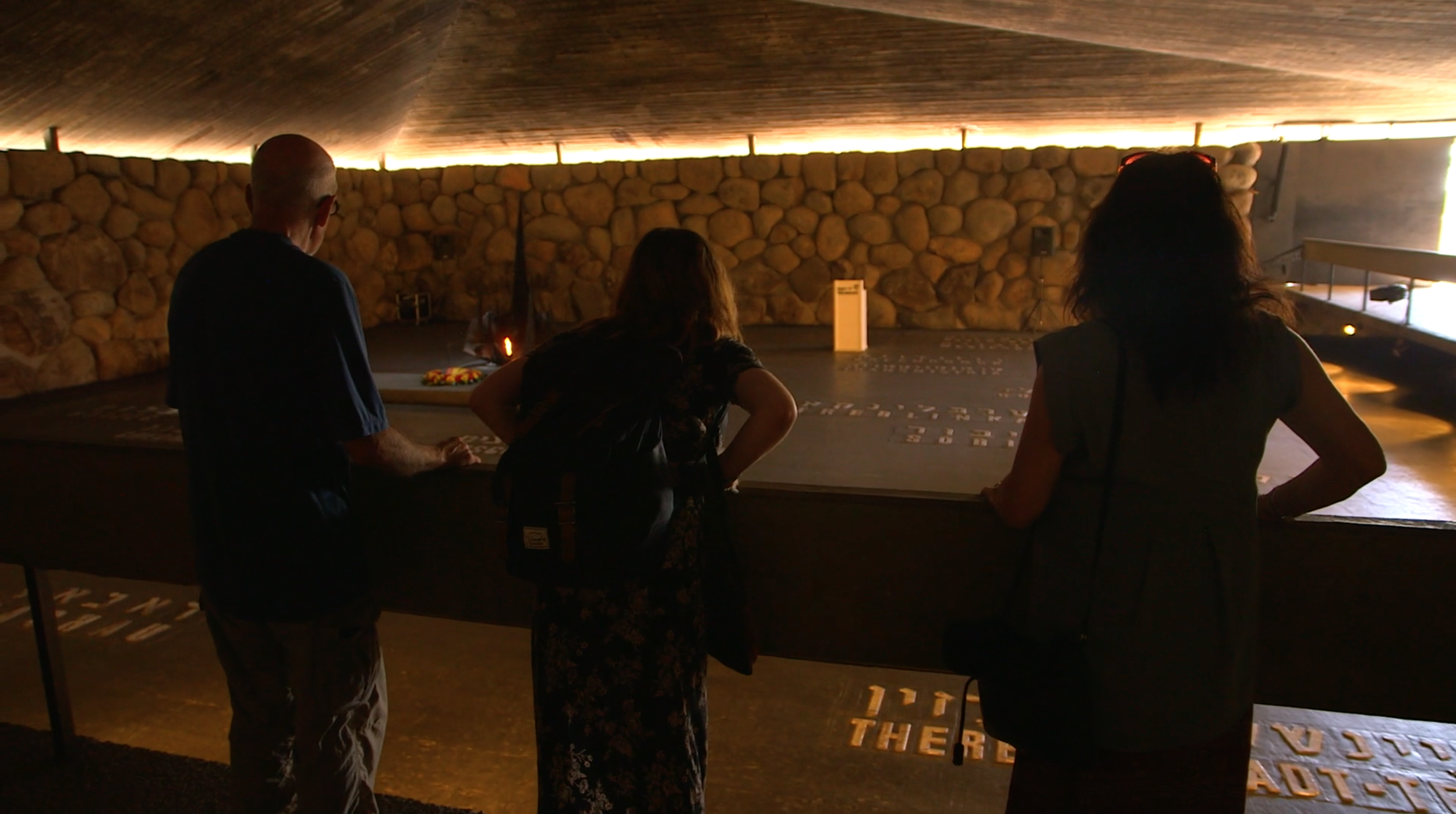
But I need to go: to find the places in the photos and see what remains of an unknown home. In my ancestral towns, Żelechów and Parysów, I anxiously walk the streets, expecting indifference or hostility. Instead, I’m welcomed with open arms. In Żelechów, Krystyna, a teacher and town historian, shows me the old photo studio and the site of my grandmother's house, then welcomes me into her class where students have never met a Jew before. In Parysów, Mayor Bozena takes me to a Jewish cemetery where only one tombstone remains unlooted. Walking over mass graves, I nearly break down knowing my ancestors could be below. At Treblinka, I do break down – overwhelmed by the emptiness and pain seared into the land and my DNA.
But the film doesn't end in Poland's past. Combining vérité and personal-documentary reflexiveness, Within the Box shows that these silences and haunted landscapes aren't just wounds to carry; they're what we must face to live fully, and joyfully, in the present.
Why now?
There will soon be entire generations who will never hear the horrors of the Holocaust directly from survivors. The youngest survivor is now 75 years old and any survivors who were old enough to have distinct memories of the camps are well into their 90s at this point. According to the Claims Conference, there are now less than 100,000 survivors living in the U.S. and by 2030, that number will dip below 10,000.
As survivors are growing older and passing away, the knowledge and memory of the Holocaust is fading from our collective memories. Another study by the Claims Conference found that 31% of Americans and 41% of millenials believe that 2 million or fewer Jews were killed in the Holocaust. That same study found that 41% of Americans and 66% of millenials do not know what Auschwitz was; it is likely that even more have never heard of Treblinka, where my family was murdered.
However, at the same time, that study found that 58% of Americans fear that something like the Holocaust could happen again and 80% believe it is critical to keep teaching about the Holocaust to ensure that history does not repeat itself. It is imperative for us to develop new ways to tell stories about the Holocaust and its lasting effects that do not solely rely on recounting the atrocities themselves. For the education to continue to be potent long into the future, it is critical to tell stories of how the trauma continues to affect the descendants of survivors, generations removed from the concentration camps. An apocalyptic event like the Holocaust forever rattled the mental health of the survivors themselves and continues to literally imprint on the minds of the descendants of survivors through epigenetic inheritance that changes our DNA, making us more predisposed to depression and suicide. Yet there still remains a massive cultural taboo around seeking out mental health services.

The specter of intergenerational trauma is also not unique to the Holocaust. Survivors of mass, cultural injustices across the world will deal with and are currently dealing with the same, generations-long fallout. While many films have detailed the direct effects of the Holocaust, Within the Box gets at the heart of the Holocaust’s lasting consequences by painting a personal portrait of how survivors’ descendants can cut through overwhelming numbers. It then pushes beyond its personal story to provide a broader picture of trauma, identity, loss, and family, giving audiences an understanding of the importance of confronting impossible-to-talk-about topics so that lives will never be forgotten and so that our engagement with our own painful pasts will open us up to empathize with the present-day suffering of others.
Support
Within the Box is fiscally sponsored by the International Documentary Association. You can make a 100% tax-deductible donation to support the production of the film here. Within the Box has been the recipient of a City of Chicago Department of Cultural Affairs and Special Events Individual Artist Program grant in 2018, 2019, and 2020. An early, short version of the film screened at the 2016 Cannes Film Festival Short Films Corner as well as at the 2016 Kartemquin Films Fall Festival.